
Understanding Solar Panel Sizes: How Dimensions Affect Efficiency
Introduction
As solar energy adoption continues to grow in Singapore, more homeowners and businesses are paying closer attention to how system design affects overall performance and cost efficiency. One factor that is often overlooked, yet highly influential, is the size of solar panels.
Solar panel dimensions play a direct role in how much electricity a system can generate, how efficiently it operates, and how well it fits within the physical constraints of a property. The right decision can maximise energy generation without overcrowding the roof and ensure long-term returns on investment.
This article explains how solar panel sizes and dimensions impact efficiency. It also covers what property owners should consider when planning a solar panel installation in the land-scarce Singapore.
Key Takeaways:
1. Why does solar panel size matter?
The size of solar panels affects how much electricity each panel produces, how efficiently your roof space is used, and the overall cost-effectiveness of the system. Proper sizing helps maximise energy output without layout inefficiencies or unnecessary costs.
2. Does a bigger solar panel always generate more power?
Generally, larger panels produce more power per panel. However, higher output does not always mean better performance if the roof layout cannot accommodate it efficiently.
3. Are smaller solar panels less efficient?
Not necessarily. Smaller panels often offer greater flexibility on roofs with space constraints or obstructions. While more panels may be needed, the overall system can still perform efficiently when well designed.
4. What are the common solar panel sizes used in Singapore?
In Singapore, residential systems typically use 60-cell panels, while commercial systems often use 72-cell or 96-cell panels. Each type is designed for different roof sizes, energy demands, and installation conditions.
5. How do I choose the right solar panel size for my property?
The right size of solar panels depends on usable roof space, roof layout, electricity consumption, sun exposure, and budget. A system should be sized to match energy needs without overspending on unused capacity.
6. Can a solar system be too large or too small?
Yes. Oversized systems increase upfront costs without proportional savings, while undersized systems reduce bill offset and slow long-term returns. Proper sizing balances performance and cost efficiency.
Singapore’s Shift Toward Solar: Understanding the Importance of Panel Size
Why the Size of Solar Panels Matters in the Energy Transition
As Singapore accelerates its transition towards renewable energy, solar power has emerged as one of the most practical and scalable solutions. With abundant year-round sunlight, limited land availability, and rising electricity costs, solar energy offers a way for homeowners and businesses to reduce long-term energy expenses while lowering their carbon footprint.
In 2022, the energy crisis led to a sharp hike in fuel prices, which in turn drove multiple revisions to Singapore’s regulated electricity tariffs across the year. As electricity costs rose for households and businesses, many began reassessing long-term energy expenses. This contributed to a significant increase in interest in solar adoption as a way to manage cost volatility and improve energy resilience. Solar panels are now commonly installed not only on residential and commercial rooftops, but also on unconventional spaces such as reservoirs and industrial buildings.
Global solar PV electricity generation costs have dropped significantly over the past decade, driven by improvements in efficiency and large-scale manufacturing. This makes solar energy more accessible to a wider range of property owners. Despite this growing adoption, many still underestimate how system design choices affect overall performance, efficiency, and cost-effectiveness.
How Different Solar Panel Sizes Influence Energy Generation
Panel size affects installation layout, efficiency, and how well a system meets energy requirements. These considerations directly influence system performance over time. When panels are sized appropriately, property owners benefit in several important ways.
1. Optimal Energy Output
Larger panel sizes generally correspond to higher power output per panel. When matched appropriately to roof capacity, they enable efficient energy generation without overcrowding or layout inefficiencies.
2. Proper Roof Fit
Roof layouts vary widely, especially in Singapore, where space constraints are common. Smaller panels offer greater flexibility for complex or limited roof areas, allowing installers to optimise placement around obstructions and maximise usable space.
3. Cost Efficiency
Correct sizing reduces unnecessary material use and installation waste. By aligning panel size with roof capacity and energy needs, systems can be designed more efficiently, improving overall solar power cost-savings and long-term returns.
What You Need to Know About Solar Panel Dimensions
While panel size is often associated with power output, solar panel dimensions relate more to layout, spacing, and installation practicality. Dimensions determine how panels are arranged on a roof, how well they work around obstacles, and how efficiently available surface area is utilised.
Panels with larger physical dimensions cover more roof area per unit. This can simplify system layouts on wide, unobstructed rooftops. However, they may pose challenges on smaller roofs or those with irregular shapes, sloping angles, or existing fixtures such as air-conditioning units and skylights.
In contrast, panels with more compact dimensions provide greater layout flexibility. Their smaller footprint allows installers to work around constraints more easily and maximise usable roof space. Although more panels may be required to achieve the same system capacity, the improved fit can result in a more efficient overall layout.
What Are the Common Solar Panel Sizes?
Once panel size and dimensions are understood in principle, the next practical question is how solar panels are typically classified in real-world installations. In most cases, solar panels fall into two broad categories, each designed to suit different roof conditions, energy demands, and installation constraints.
1. Residential Solar Panels
Residential solar panels in Singapore are commonly built using a 60-cell configuration, which balances power output with manageable size and weight. These panels are designed to work well on homes with limited roof space or more complex roof layouts.
- Average dimensions: approximately 1.65 m × 1.00 m
- Weight: around 18–20 kg per panel
- Typical power output: 350–450 W
- Common applications: landed properties, HDB rooftops, and small-scale residential systems
These panels are lighter and easier to manage during installation, placing less stress on rooftop structures. Thanks to their compact form, installers can work around features like water tanks, air-conditioning units, or uneven roof surfaces. This means they are well-suited for homes where roof space needs to be used efficiently.
2. Commercial Solar Panels
Commercial solar panels typically use 72-cell or 96-cell configurations, designed to deliver higher output per panel. These are ideal for large, open roof areas with minimal layout constraints and high energy demand.
- Average dimensions: approximately 2.00 m × 1.00 m for 72-cell panels; and approximately 2.20 m × 1.05 m for 96-cell panels
- Weight: around 22–28 kg per panel
- Typical power output: 500–700 W
- Common applications: commercial buildings, factories, warehouses, and industrial rooftops.
Larger commercial panels generate more electricity per unit, reducing the total number of panels required to reach a target capacity. This can lower overall mounting, wiring, and installation complexity. Over time, the higher output per panel also contributes to better cost efficiency on a per-watt basis.
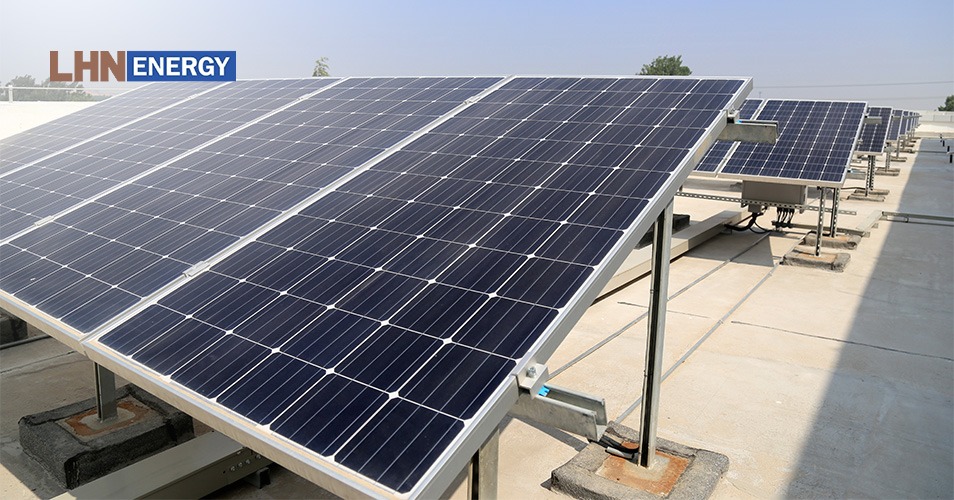
By understanding standard solar panel sizes and their intended applications, homeowners and businesses can better align solar panel system design with practical installation considerations. This helps optimise space, performance, and cost efficiency from the outset.
What Efficiency and Panel Size Mean in Solar Design
When discussing solar performance, it is important to distinguish between efficiency and panel size, as they influence a system in different ways.
‘Efficiency refers to the percentage of sunlight a panel can convert into usable electricity and is largely determined by the underlying solar cell technology. Higher efficiency panels generate more power from the same amount of sunlight, but this does not automatically mean they are the best fit for every property.
Panel size, on the other hand, relates to physical dimensions, wattage per panel, and how densely panels can be arranged on a roof. Even panels with slightly lower efficiency can perform exceptionally well when their size allows for better layout optimisation, improved spacing, and fuller use of available roof area.
Planning Your Solar Energy System: What Homeowners Should Know
What to Consider When Choosing Solar Panel Size
Selecting the right solar panel size is not a one-size-fits-all decision. It requires balancing physical constraints, energy requirements, and long-term financial goals. Understanding the factors below helps ensure your solar system is designed to perform efficiently while making the best use of available space and investment.
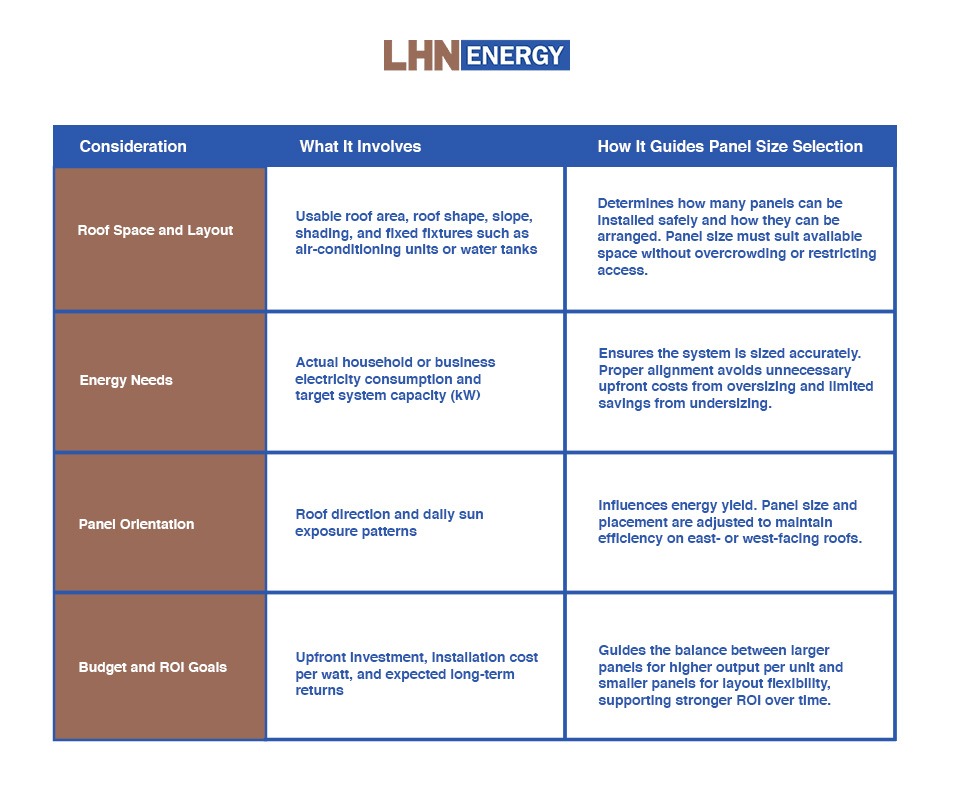
| Consideration | What It Involves | How It Guides Panel Size Selection |
|---|---|---|
| Roof Space and Layout | Usable roof area, roof shape, slope, shading, and fixed fixtures such as air-conditioning units or water tanks | Determines how many panels can be installed safely and how they can be arranged. Panel size must suit available space without overcrowding or restricting access. |
| Energy Needs | Actual household or business electricity consumption and target system capacity (kW) | Ensures the system is sized accurately. Proper alignment avoids unnecessary upfront costs from oversizing and limited savings from undersizing. |
| Panel Orientation | Roof direction and daily sun exposure patterns | Influences energy yield. Panel size and placement are adjusted to maintain efficiency on east- or west-facing roofs. |
| Budget and ROI Goals | Upfront investment, installation cost per watt, and expected long-term returns | Guides the balance between larger panels for higher output per unit and smaller panels for layout flexibility, supporting stronger ROI over time. |
1. Roof Space and Layout
The first consideration is how much usable roof space is available. It is not only about roof size, but also the shape of the roof, its slope, areas of shading, and the presence of fixtures such as air-conditioning units or water tanks.
Carefully assessing the layout helps determine how many panels can be installed safely and efficiently. Many residential roofs in Singapore have uneven or constrained layouts. Solar panel size and arrangement must therefore be planned thoughtfully to fit available space. This helps ensure efficiency without compromising safety or accessibility.
2. Energy Needs
The size of solar panels should align with your actual electricity consumption. Reviewing past utility bills provides a clearer picture of how much energy your household or business uses. It also allows you to gauge an appropriate system capacity, usually measured in kilowatts (kW). Properly matching panel size and quantity to energy demand maintains effective energy generation.
When a system is oversized, more panels are installed than are needed to meet electricity demand. This increases upfront costs for panels, mounting structures, wiring, and installation, but the extra capacity may not be fully utilised.
On the other hand, an undersized system generates less electricity than the property requires. While the initial cost is lower, the system offsets only a portion of the electricity bill, limiting long-term savings and extending the payback period.
3. Panel Orientation
Roof orientation has a direct impact on solar exposure and energy production. Due to Singapore’s position near the equator, solar panel compass orientation is less critical than in higher-latitude countries. Panels receive relatively consistent solar exposure throughout the year, regardless of whether they face east, west, or are laid close to flat.
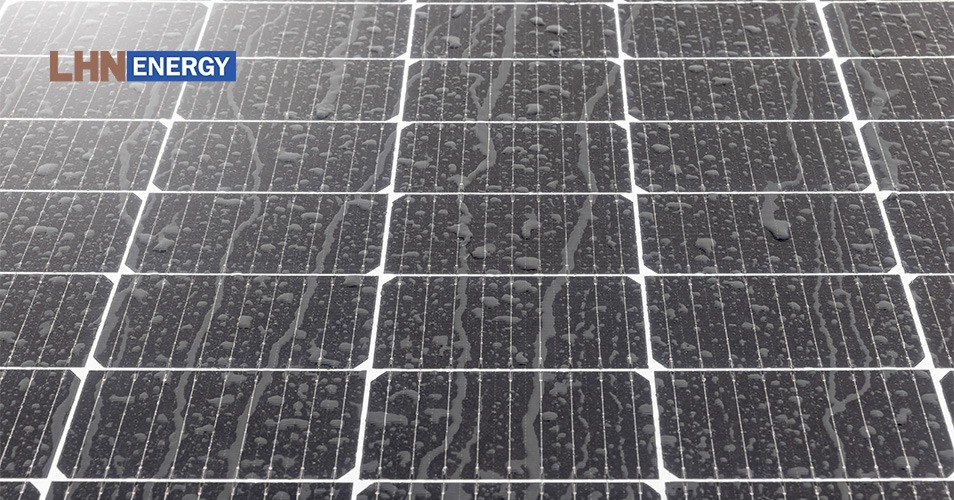
As a result, installation design in Singapore should prioritise shade avoidance, safe roof setbacks, and efficient layout over directional orientation. Panels are typically mounted above and parallel to the roof surface with adequate clearance to allow airflow and reduce heat buildup. They may also be installed at a slight tilt to facilitate rainwater runoff and minimise soiling. Keeping panels free from shading by nearby structures or future developments is essential, as even partial shading can significantly reduce system output.
4. Budget and ROI Goals
Budget is also an important factor when deciding on solar panel size. Larger panels often generate more power per unit, which can reduce installation costs per watt by lowering the number of panels required. However, smaller panels may offer better flexibility for roofs with space constraints, allowing for more efficient layouts.
Balancing upfront costs with long-term returns helps ensure the system meets both financial and performance expectations. Choosing the right size improves cost efficiency and return on investment (ROI) over time.
What are Some Installation Design Considerations for Solar Panel Systems?
Once the appropriate solar panel size has been determined, the next step is translating those calculations into a practical, well-designed installation. Even a properly sized system may underperform if factors such as roof layout, orientation, and structural support are not carefully considered. In this section, we outline the key installation design considerations that influence system performance and long-term reliability.
1. Roof Layout and Orientation
The configuration of your roof directly affects system capacity and performance. Factors like roof geometry, pitch, and available mounting space determine how efficiently solar panels for commercial buildings or residential properties can be arranged.
In Singapore, south-facing roofs generally receive the most consistent sunlight throughout the year, resulting in higher and more stable energy output. However, even east- or west-facing roofs can still perform well with proper system design. It is also important to assess potential shading from nearby trees, neighbouring buildings, or rooftop fixtures, as even partial shading can significantly reduce overall system efficiency.
2. Tilt Angle and Sunlight Exposure
Because Singapore is located near the equator, solar panels do not require steep tilt angles to perform optimally. A tilt of approximately 10–15 degrees is recommended, as it balances maximum sunlight exposure with practical considerations such as rainwater runoff. Proper tilt also improves airflow beneath the panels. This aids heat dissipation and maintains efficiency in Singapore’s warm climate, especially for flat-roof installations.
Panels installed at angles below 10 degrees may experience performance losses over time. Water can be trapped by the panel frame, allowing dust and dirt to accumulate as moisture evaporates.
Tilting panels beyond 20 degrees is also generally less suitable in Singapore’s context. Steeper angles reduce the capture of near-overhead sunlight and can increase the risk of reflected glare affecting nearby buildings. In practice, installation design should focus on achieving an appropriate tilt that supports natural cleaning through rainfall, limits reflection concerns, and delivers stable energy output under local conditions.
3. Mounting Structure and Materials
The mounting system is a long-term structural component that ensures solar panels remain securely fixed under varying weather conditions. Given Singapore’s high humidity, frequent rainfall, and occasional strong winds, mounting structures must be built from corrosion-resistant materials such as aluminium or galvanised steel.
A well-designed mounting system does more than secure the solar panels in place. It helps distribute weight evenly across the roof, reducing stress on existing structures and preserving long-term roof integrity. Proper mounting design also minimises the risk of water ingress, which is especially important in Singapore’s humid climate.
On top of that, compliance with Building and Construction Authority (BCA) structural safety requirements ensures the system is designed to withstand these conditions. This reduces structural risks and supports safe, stable operation over time. For homeowners, it provides greater confidence in the system’s durability, safety, and long-term performance.
What to Expect Ahead: Compact High-Efficiency Panels
As solar adoption continues to grow in Singapore, panel technology is evolving to address the space and climate constraints faced by many homeowners. The next generation of solar panels is focused on delivering higher energy output without increasing physical size, making solar systems more accessible and efficient across a wider range of properties.
1. Smaller Frames, Higher Power
Solar technology advancements are allowing manufacturers to pack more power into smaller panel formats. Technologies such as N-type cells, TOPCon, and bifacial solar panel designs improve electrical efficiency and reduce energy losses. As a result, homeowners can achieve higher energy output with fewer panels, while maintaining system reliability and longevity.
2. Optimised for Urban Environments
Compact, high-efficiency panels are suitable for Singapore’s dense urban landscape, as they maximise energy output within limited space. Many homes face constraints such as irregular roof shapes, limited usable surface area, or shading from nearby buildings. By delivering higher power output per square metre, these panels allow homeowners to make better use of available roof space and maintain safe access.
3. Better Heat Performance
Newer solar cell technologies are also designed to perform more consistently in hot and humid conditions. Improved heat tolerance reduces efficiency losses during peak daytime temperatures, which are common in Singapore’s tropical climate. This leads to more stable energy production throughout the year and better long-term returns for homeowners.
Frequently Asked Questions
1. Does a larger solar panel mean higher efficiency?
Not always. Solar panel efficiency depends more on cell technology and materials than physical size. For example, a smaller monocrystalline panel can outperform a larger polycrystalline panel if it uses higher-quality cells. However, larger panels can produce more energy per unit installed, making them more efficient in terms of space utilisation for commercial projects.
2. Can I install large commercial-sized panels on a residential roof?
It’s possible, but not always recommended. Large panels may be too heavy or oversized for smaller residential rooftops and can complicate installation and maintenance. Installers from certified solar companies in Singapore can assess your roof structure and recommend the most suitable option based on safety, roof load capacity, and available space.
3. Can solar panel size impact long-term maintenance?
Yes. Larger panels may be harder to access for cleaning or inspection, especially on compact rooftops. Smaller or mid-sized panels offer easier maintenance and can be replaced individually if damaged, improving long-term system reliability.
Conclusion
Choosing the right solar panel size is essential for achieving optimal efficiency, cost-effectiveness, and compatibility with your roof layout. A well-sized solar panel for homes or businesses delivers sufficient energy without unnecessary costs or space limitations. Proper planning and professional system design are just as important. They help maximise energy output and ensure long-term reliability, while meeting Singapore’s regulatory and structural requirements.
Working with a certified and experienced installer like LHN Energy allows these factors to be carefully assessed and aligned from the outset. LHN Energy has been a pioneer in Singapore’s solar industry since 2018. As a comprehensive solar solutions provider, we offer solar panel installations, EV chargers, solar PPA options, and full solar EPC services for residential, commercial, and industrial projects.
Consult us today to determine the ideal solar panel size for your property. Let’s take the next step towards a more efficient and sustainable energy solution.