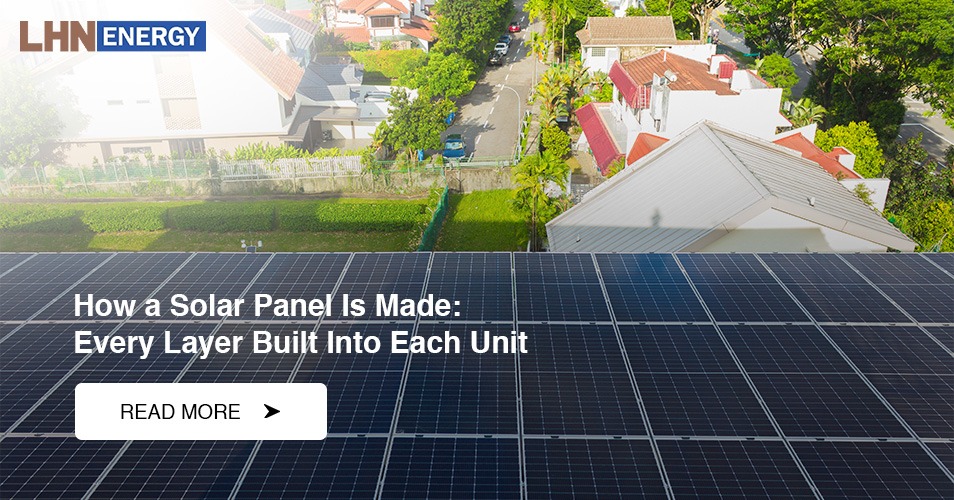
How a Solar Panel Is Made: Every Layer Built Into Each Unit
How a Solar Panel Is Made: Every Layer Built Into Each Unit
As climate change drives a push for sustainability, making eco-friendly choices can now offer significant financial benefits. One of the most effective ways to save money on energy bills while reducing your carbon footprint is by harnessing renewable energy, with solar panels standing out as a practical solution. By converting sunlight into electricity, solar panels can power your home and lower your reliance on costly fossil fuels. Over time, this means major savings as you cut down on traditional energy costs and protect yourself from rising electricity prices.But how exactly do solar panels create electricity?
How Solar Panels Work: The Science Behind Energy Conversion
A solar panel is a precisely layered assembly — each material serves a specific structural or electrical purpose
Solar cells account for the largest share of a panel’s cost; their quality determines both efficiency and lifespan
Understanding what a panel is made of helps you evaluate repair options, maintenance needs, and why some panels cost more than others
Build quality at every layer directly affects how much electricity a panel produces and how long it lasts
For property owners in Singapore, where high UV exposure and humidity are constant, knowing what is inside a panel is the first step to making a confident investment decision
To understand how do solar panels create electricity, it’s essential to know the main components that make up a solar panel system. Each part plays a specific role in the energy production and storage process, helping the system operate efficiently and reliably.
Introduction
A solar panel may look like a simple sheet of glass mounted on a rooftop. Look closer, and it is something else entirely: a precisely engineered stack of materials, each layer performing a distinct role in capturing sunlight and enabling electricity to flow.
If you have ever wondered why solar panels cost what they do, whether a damaged one can be fixed, why they look the way they look, or what actually wears out over time, the answers all trace back to what is physically inside the unit.
For property owners in Singapore, where high UV exposure, humidity, and consistent sunlight make solar both a practical and durable investment, knowing what is inside a panel is the first step to making a confident decision.
This article takes each layer apart, in the order it is assembled, and explains what it does and why it matters to you as a property owner.
It Starts With Silicon
Before a panel takes shape, it begins at the cell level. Raw silicon, one of the most abundant materials on earth, is refined into a semiconductor material capable of reacting to light. This refined silicon is formed into wafers, doped with phosphorus to give each wafer an electrical charge, and cut into the individual solar cells that will eventually generate electricity.
Each cell produces a small amount of power on its own. Multiple cells are soldered together in series to build sufficient voltage, then assembled into the rectangular panel configuration familiar on rooftops across Singapore.
Why this affects solar power panels cost: Silicon purification and cell manufacturing are the most energy-intensive and capital-heavy stages of panel production. The quality of the silicon used, and the precision of the doping and cutting process, directly determines how efficiently the finished panel converts sunlight. This is the primary reason high-efficiency panels carry a premium price.
Layer 1: The Aluminium Frame
Assembly begins with the frame. An extruded aluminium border surrounds and supports the entire panel structure, providing rigidity against wind, rain, and physical stress. It also creates the mounting points that allow the panel to be secured to a roof or ground structure.
“Can a bent or cracked frame be repaired?” In most cases, yes. Frame damage from impact or improper handling is one of the more straightforward repair scenarios. Because the frame is external and mechanically separate from the cell stack, a qualified solar panel installer can often replace or reinforce it without disturbing the internal layers. Frame integrity will be assessed as part of routine inspection, flagging early-stage corrosion or physical deformation before it affects panel output or mounting stability.
Layer 2: Tempered Glass
Directly inside the frame sits the front-facing glass layer. This is low-iron tempered glass, typically 3 to 4mm thick, chosen for its ability to transmit maximum sunlight while withstanding impact, hail, and thermal expansion. An anti-reflective coating is applied to the surface to reduce light bounce and increase the amount of sunlight reaching the cells below.
“Why does my panel look slightly blue or green from certain angles?” The tint comes from the anti-reflective coating on the glass, not the cells themselves. It is a normal optical property of the coating material and does not indicate a defect. The coating is applied specifically to improve light capture — the visual effect is a byproduct of the physics involved.
“So can cracked glass be repaired?” Glass cracking is one of the more serious panel damage scenarios. Unlike frame damage, a cracked front layer compromises the sealed environment that protects the cells and encapsulant from moisture. In most cases, a cracked panel requires replacement rather than repair. Regular visual inspections by a solar company in Singapore, particularly after severe weather, help catch micro-cracks early, before moisture ingress causes internal degradation.
Layer 3: Front Encapsulant (EVA)
Between the glass and the solar cells sits the first encapsulant layer, typically ethylene vinyl acetate (EVA). This transparent material bonds the glass to the cells during lamination under heat and pressure. It seals out moisture and prevents the cells from shifting or cracking under mechanical stress.
Why this affects maintenance frequency: EVA degradation is one of the primary causes of long-term panel performance loss. Over time, particularly in high-UV environments like Singapore, the encapsulant can yellow, reducing light transmission to the cells below. This process is gradual and typically becomes measurable after 10 to 15 years.
Higher-grade encapsulants degrade more slowly, which is one of the quality differentials between budget and premium panels. Experienced professionals on solar panels and installation will specify encapsulant grade alongside cell efficiency when recommending a panel.
Layer 4: Solar Cells
The solar cells sit at the centre of the stack: the functional core of every panel and the single largest cost driver in its manufacture. Each cell is a thin silicon wafer that reacts to photons in sunlight, releasing electrons and generating direct current (DC) electricity. Cells are arranged in a grid pattern and connected by thin metallic strips called busbars and ribbons, which collect and channel the current toward the junction box. What makes up the biggest cost of a solar panel?
The solar cells themselves, specifically the silicon wafer production, doping, and metallisation processes, account for approximately 40 to 50 percent of a finished panel’s manufacturing cost. The glass, frame, encapsulant, and junction box make up the remainder. This is why panel prices track silicon commodity prices globally, and why higher-efficiency panels command a meaningful premium over standard options.
The three cell types and what they mean for your property:
Monocrystalline cells — cut from a single silicon crystal; highest efficiency, uniform dark appearance, best suited to properties with limited roof space where every square metre of panel needs to produce as much as possible
Polycrystalline cells — cast from multiple silicon fragments; slightly lower efficiency, bluish tone, lower cost — a practical choice where roof space is not a constraint and upfront cost is a priority
Thin-film cells — deposited in layers onto a substrate; lower efficiency but flexible, making them viable for curved surfaces, skylights, or building-integrated applications uncommon in standard residential installs
Layer 5: Rear Encapsulant (EVA)
A second EVA layer sits beneath the solar cells, mirroring the front encapsulant. It bonds the cells to the backsheet below and provides the same moisture and mechanical protection from the rear. The quality of this layer matters as much as the front, moisture that enters from the rear is just as damaging to cell performance as moisture from above.
Layer 6: Backsheet
The backsheet is the rearmost layer of the panell, a polymer-based film that provides electrical insulation and environmental protection from the back. It prevents moisture ingress, UV degradation, and electrical leakage. Why this affects maintenance: Backsheet delamination, where the polymer film begins to separate or crack, is a known failure mode in lower-quality panels, particularly in high-humidity climates like Singapore’s. Once the backsheet is compromised, moisture can enter from behind and degrade both the rear encapsulant and the cells. Visual inspection of the backsheet during routine maintenance catches early-stage delamination before it becomes a cell-level problem and the solar panel maintenance cost skyrockets.
Layer 7: Junction Box and Bypass Diodes
Mounted on the exterior of the backsheet, the junction box is where the panel’s internal wiring meets the external cables connecting it to the rest of the solar system. Inside the junction box sit bypass diodes; small electrical components that prevent power loss when individual cells or strings of cells are shaded or underperforming.
“So why does my panel output drop when part of the roof is shaded?” Without bypass diodes, a shaded cell acts as a resistor, pulling down the output of every cell connected to it in series — not just the shaded one. Bypass diodes reroute current around the affected string, limiting the loss to the shaded section only. Higher-quality panels include more bypass diodes, which reduces the impact of partial shading on overall output. This is a specification detail worth discussing with your installer if your roof has any obstructions (chimneys, water tanks, adjacent structures) that create shading at certain times of day.
“Can junction box faults be repaired?” Yes. Junction box issues like loose connections, failed diodes, or water ingress at the cable entry points are among the more serviceable panel faults. A qualified technician can open and reseal the junction box, replace diodes, or re-terminate connections without replacing the panel itself.
Layer 8: Busbars, Ribbons, and Conductive Strips
Running across the face of the solar cells are thin metallic conductors (busbars and ribbons) that collect the electrical current generated at cell level and carry it toward the junction box. The number of busbars per panel has increased over time: older panels used 2 to 3 busbars; modern panels commonly use 5, 6, or more. More contact points reduce resistive losses and distribute mechanical stress across the cell surface, reducing micro-crack risk.
Why this matters for longevity: Micro-cracks in solar cells (hairline fractures invisible to the naked eye) are a common cause of gradual output degradation. They often originate from mechanical stress during transport, installation, or thermal cycling. Panels with more busbars are more resilient to micro-crack propagation because current has more pathways to travel even if one is interrupted.
Electroluminescence (EL) imaging during installation or maintenance can detect micro-cracks before they become measurable output losses.
From Layers to Output: Why Build Quality Is an Investment Decision
Every material in the stack has a purpose. The frame holds. The glass transmits. The encapsulant protects. The cells generate. The backsheet insulates. The junction box connects. Together, they form a unit that converts sunlight into electricity reliably across 25 years or more, provided each layer is built to standard.
The difference between a budget panel and a premium one is not visible from the outside. It sits in the silicon purity, the encapsulant grade, the busbar count, the backsheet polymer specification, and the bypass diode configuration. These are the factors that determine how the panel performs in year 5, year 10, and year 20, not just on the day it is installed.
For property owners in Singapore, where the climate combines high UV exposure, humidity, and occasional extreme weather, specifying the right panel at the outset reduces maintenance frequency, extends replacement cycles, and protects the financial return on the system.